Showing posts with label challenge. Show all posts

Thursday, July 28, 2016

'Ice Bucket Challenge' funds ALS gene breakthrough


Two years after the ALS Ice Bucket Challenge craze on social media, researchers say money raised from the campaign has funded the discovery of a new gene linked to the disease.
The gene, identified as NEK1, has been found to contribute to hereditary Amyotrophic Lateral Sclerosis, or Lou Gehrig's disease. The gene is associated with three per cent of all ALS cases, according to the ALS Association.
ALS is a rapidly-progressing, neurodegenerative disease that paralyzes muscles and destroys nerve cells. It currently has no cure and is often fatal, although some individuals, including Stephen Hawking, live with it for decades.
Researchers are now focused on understanding how the NEK1 gene contributes to the development of ALS, so they can develop a gene therapy for it. It's not yet known whether it's the only factor necessary to pass on the inherited disease. It is possible to test for the gene, but researchers say the results are difficult to interpret at this point, even if NEK1 is present.
An international team of researchers at Project MinE made the discovery and published their findings in the journal Nature Genetics.
Project MinE was one of six projects funded by the ALS Ice Bucket Challenge. The phenomenon went viral with the help of a number of celebrities, who dumped ice-cold water on their heads before issuing a challenge to someone else to join in the fun and donate to charity.
Nancy Frates, who helped start the Ice Bucket Challenge with her son, Pete, says it's "overwhelming" to see this discovery come out of their efforts.
The Frates launched the ALS Ice Bucket Challenge after Pete was diagnosed with the disease at the age of 27. Pete Frates had been a baseball player at Boston College before his diagnosis, but the effects of ALS confined him to a wheelchair and robbed him of most of his ability to move.
Nancy Frates said her son's story helped people recognize that ALS can afflict anyone, regardless of age.
"They thought it only happened to old people, so when a big strapping athlete gets this disease, a whole new generation has woken up," she told CTV News Channel on Wednesday. "We knew that this disease needed the awareness and the education."
Frates said she wasn't surprised by the social media reaction to the campaign. "We knew we had a relatable story, a compelling story," she said. "When the vehicle came along people just took hold of it and just joined us."
The campaign raised US$220 million for ALS research, Frates said.
Original post found here:



Saturday, June 4, 2016

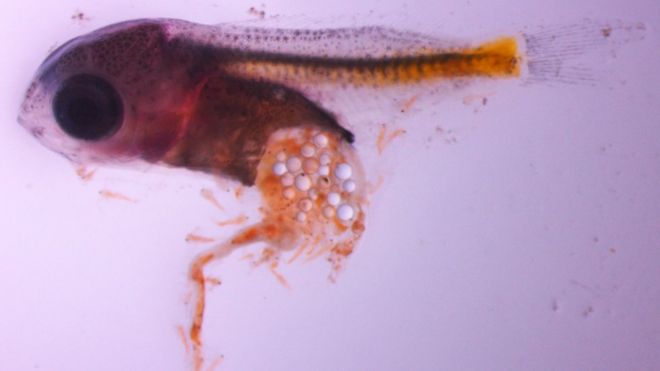
Fish eat plastic like teens eat fast food, researchers say


Young fish become hooked on eating plastic in the seas in the same way that teenagers prefer unhealthy fast food, Swedish researchers have said.

Their study, reported in Science, found exposure to high concentrations of polystyrene makes perch larvae favour the particles over more natural foods.
As a result of exposure to plastic, the young perch are smaller, slower and more susceptible to predators.
The researchers called for plastic micro-beads to be banned in cosmetics.

Chemical degradation

Concerns have been growing about the amount of plastic in the seas in recent years.
A study that came out last year estimated that about 8 million tonnes of plastic waste enters the oceans annually.
I think of it as unhealthy fast food for teenagers, and they are just stuffing themselves
Dr Oona Lonnstedt, Uppsala University
When exposed to UV radiation, chemical degradation and the movement of the waves, this plastic breaks down into tiny pieces. Those smaller than 5mm are referred to as micro-plastics. The term also covers plastic micro-beads from personal care products.
Scientists have been worried that these tiny fragments can build up in the guts of marine creatures and can also leach toxic chemicals.

To look at the impact of micro-plastics on the early life stages of fish, Swedish researchers exposed perch larvae to different concentrations of polystyrene in water tanks.
In the absence of micro-plastics, about 96% of the eggs successfully hatched. This dropped to 81% for those exposed to large quantities.

'Stuffing themselves'

The fish that did hatch in these waters with high quantities of micro-plastics were "smaller, slower, and more stupid" than those that hatched in clean waters, lead author Dr Oona Lonnstedt, from Uppsala University, said.
When exposed to predators, about half the young perch from clean waters survived for 24 hours. Those that had been raised with the strongest plastic concentrations were all consumed by pike over the same period.
Most surprising for the research team was the way that plastic changed food preferences.
"They all had access to zooplankton and yet they decided to just eat plastic in that treatment. It seems to be a chemical or physical cue that the plastic has, that triggers a feeding response in fish," Dr Lonnstedt told BBC News.

"They are basically fooled into thinking it's a high-energy resource that they need to eat a lot of. I think of it as unhealthy fast food for teenagers, and they are just stuffing themselves."
In the study, the researchers link the decline of species such as perch and pike, observed in the Baltic Sea over the past two decades, to increased deaths at the juvenile stage. They argue that if plastics are impacting young fish across species, it could have "profound effects" on ecosystems.

'Silent threat'

Other researchers said the new study was an important step forward in understanding the mechanisms of impact on marine species.
"The observations we have so far are about the amount of plastic we find in the seas, and the amount we find within animals," commented Dr Erik Van Sebille from Imperial College London.
"Your intuition would say it is not good for a fish to eat plastic, but scientifically you want to prove it, you want to be able to show what the impacts plastic are having, and that has been very hard to determine until now, and that's why this is such a big paper."
The US has banned the use of plastic micro-beads in cosmetic and personal care products and there is growing pressure in the UK and Europe to do the same.
"It's body care products, it's not just toothpaste and scrubbers; some mascara and some lipsticks have plastic in them too," said Dr Lonnstedt.
"It's a silent threat that we haven't really thought about before. We need to ban the products that have micro-beads in them."
Ministers in the UK have already said that if the EU cannot adopt a common position on the issue then Britain is prepared to ban them unilaterally.
The House of Commons Environmental Audit Committee will be questioning witnesses about micro-plastics next week.
Follow Matt on Twitter @mattmcgrathbbc and on Facebook.

Source by...http://www.bbc.com/news/science-environment-36435288